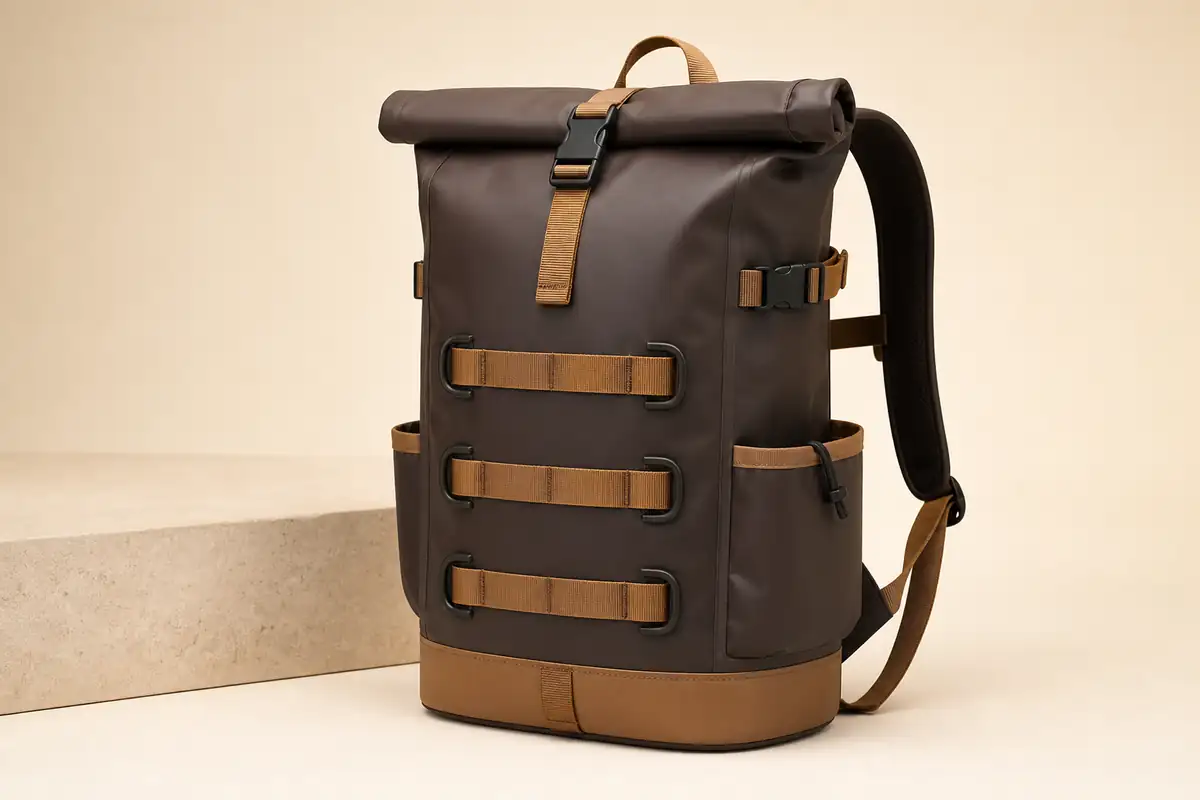
Roll-top packs look simple in a catalogue. In development, they are a chain of connected decisions. Change the fabric and the seams may need to change. Add capacity and the harness geometry becomes more important. Ask for a stronger waterproof claim and the closure, construction and test method all need to support it. Buyers get better samples when these choices are made as one system.
Begin with use, not a generic specification
A commuting pack, a kayak excursion bag and a resort activity backpack do not need the same construction. A good brief explains the intended user, load, exposure to rain or splash, trip length, retail position and destination market. It should also name the preferred 25L or 35L capacity and whether the bag needs side pockets, lash points, a waist strap or a laptop sleeve.
This context helps a manufacturer make practical trade-offs. An open mesh pocket may be useful for a bottle but unsuitable for a cleaner technical silhouette. A padded back panel can improve comfort but may affect drying time. The right answer depends on the range, not on the longest possible feature list.
“Waterproof fabric” is not a finished-bag claim
Coated TPU, PVC and recycled coated material directions differ in hand feel, weight, appearance, price and construction compatibility. Yet material selection alone does not establish how the finished backpack performs. Needle holes, seam treatment, zipper choice, roll count and opening geometry all influence the result.
Pay attention to the top opening
The roll-top is both a closure and a capacity-control feature. During sampling, check how many folds are needed, whether the buckle can be operated with gloves, how the opening behaves when the bag is lightly filled and whether the top interferes with shoulder carry. A closure that looks neat when empty may become awkward once the main compartment is packed.
For a two-size range, keep the visual language consistent while reviewing opening circumference and strap length separately. Simply enlarging every dimension can create a wide, unstable pack.
Carry comfort has to match the proposed load
Ask the supplier to explain the back panel, shoulder-strap foam, sternum strap, top handle and anchor reinforcement. A 35L version usually needs more than a larger body pattern. It may require wider straps, adjusted attachment angles and a more stable base. Load the sample with a realistic weight and walk with it; an unloaded showroom review will not reveal pressure points or sway.
What belongs in the sample review?
- Finished dimensions, usable capacity and roll-top operation at different fill levels.
- Material colour, surface, backing and seam or weld appearance.
- Shoulder-strap position, padding, sternum strap and back-panel comfort.
- Base reinforcement, lash points, buckles, zippers and high-load anchors.
- Logo size and position when the bag is filled and being worn.
- The agreed weather-protection or leakage test, recorded with a clear method.
- Labels, packaging, carton quantity and any market-specific information.
Compare quotations on equal assumptions
A low quotation may reflect a different coating, thinner webbing, standard buckles or simpler reinforcement. Before comparing suppliers, place material, capacity, hardware, logo method, packaging, quantity and test requirements in the same table. Ask which points are included and which will be confirmed after sampling.
MOQ should be treated in the same way. It is affected by material colour, component minimums, size split, print or logo method and packaging. A useful supplier explains the constraint instead of giving one number for every project.
A concise RFQ that earns a better response
Send the target capacity, intended use, expected quantity, destination market, preferred material direction, reference images or drawings, compartments, carry requirements, logo files, packaging and testing needs. Add the target timing and identify which details are fixed versus open to factory recommendation.
For a starting product direction, review our custom waterproof roll-top backpack manufacturer page. Related buyers may also compare the waterproof adventure duffel when shoulder carry and open packing are more important than a backpack harness.